For the people who decide what land is for.
Harrier is built for organisations that make land decisions across a large holding, where a decision has to be argued before a committee, a board or a set of trustees, or to a promoter who wants to cross the land, and has to hold up afterwards.
Choose between options, not between advocates.
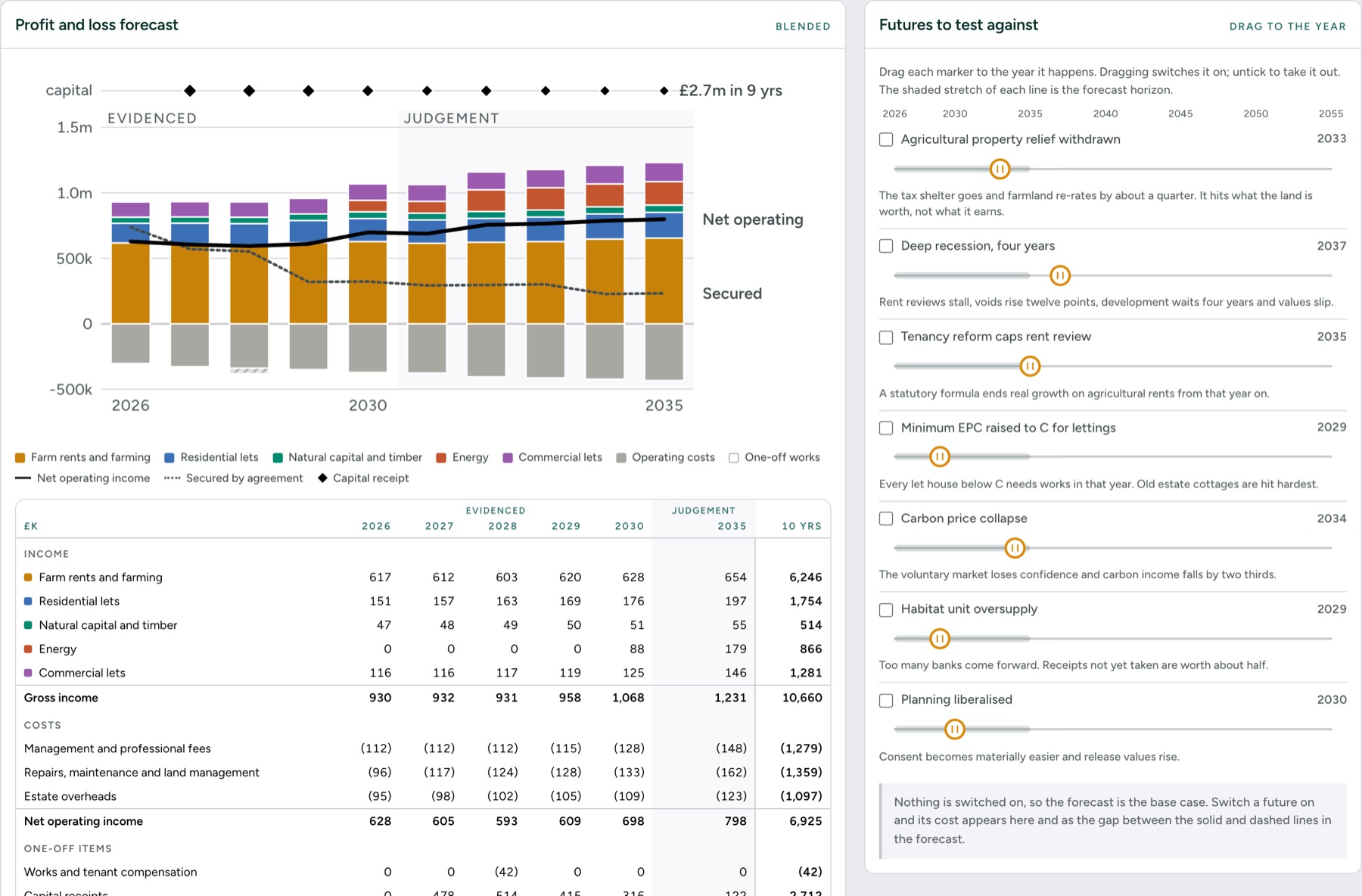
Your Head of Agriculture, Head of Forestry, development team and land agents each know their own numbers. What nobody has is a way to put a forestry decision and a habitat bank offer on the same screen, in the same money, over the same years.
- “We can’t see the trade-off.”Each enterprise reports its own way, so the executive committee weighs presentations rather than options.
- “The strategy took eighteen months and is already out of date.”Tenancies end, the plan review comes round, a new offer lands, and the document doesn’t move.
- “I want to rewild, but I can’t see what it costs.”The new options come with thirty-year terms and no cash flow anyone trusts.
How Harrier helps
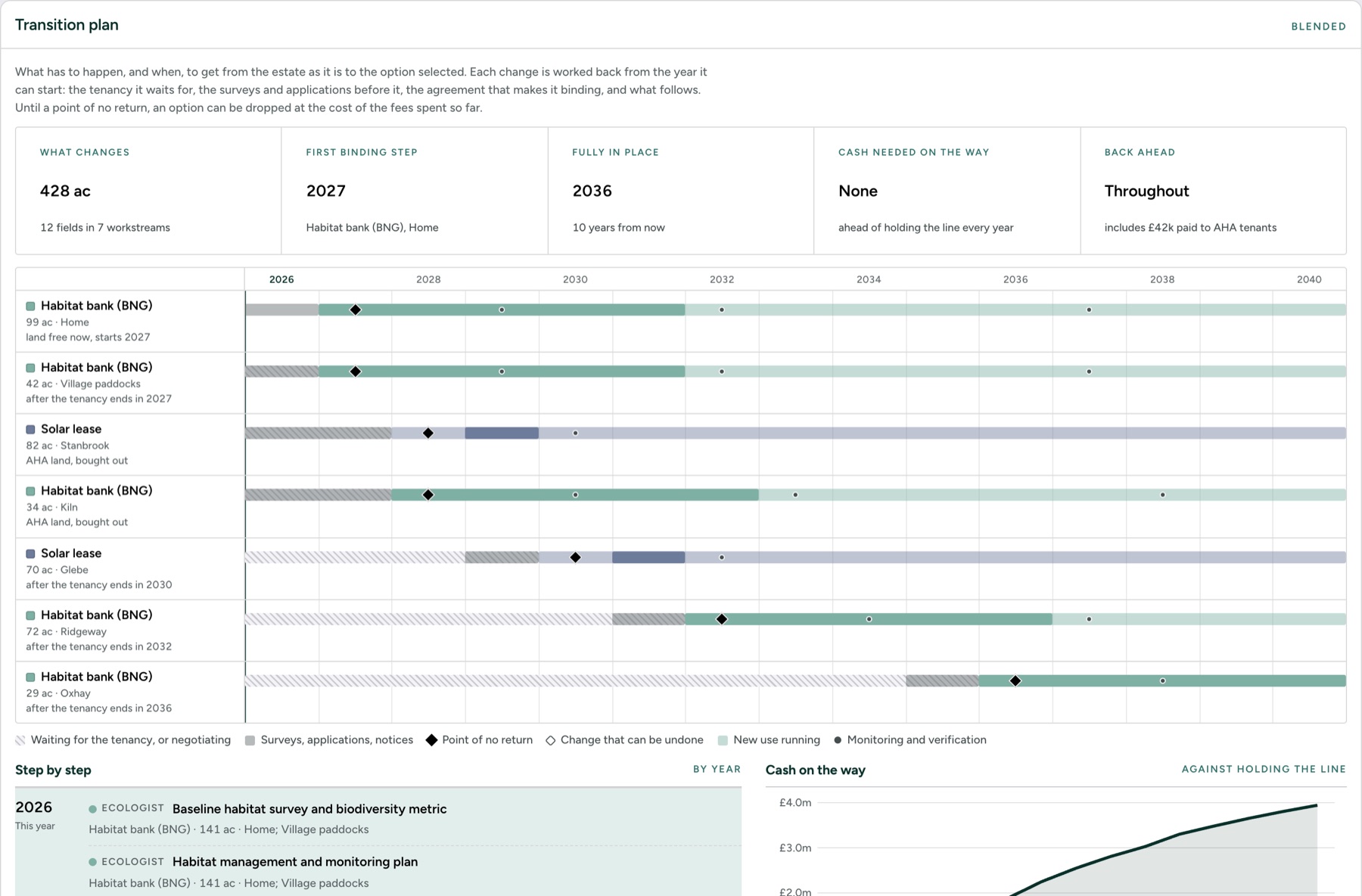
One picture across every enterprise, every option priced against the strategy you already have, a transition plan worked back from the tenancies, and a record of why the committee chose what it chose.
Hundreds of places. Thousands of tenancies. Act where it counts.
Restore nature, keep farm businesses viable, slow the water, cut carbon, open up access, and replace the revenue nature gives up, often on the same farms. Harrier runs the judgement your teams make by hand across the whole portfolio, and keeps it current.
- “We mapped half our tenancies at real expense. Keeping it current is the hard part.”One-off analysis ages. Harrier keeps the prioritisation live as tenancies, surveys and schemes change.
- “The carbon, habitat and terrier data are separate.”Harrier bridges the systems you already run rather than asking you to replace them.
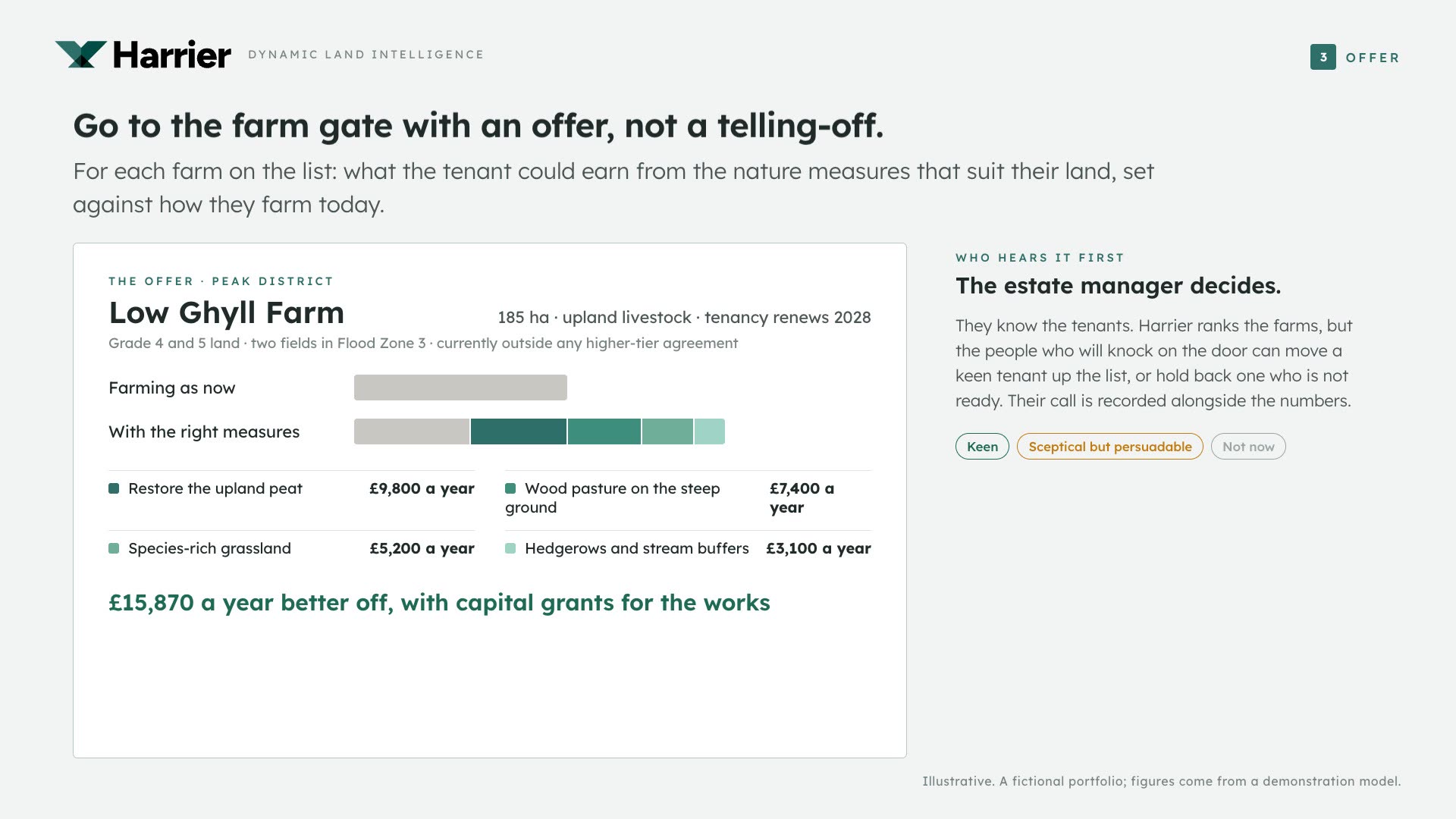
- “We want a positive offer at the farm gate.”For each farm: what the tenant could earn from the nature measures that suit their land, and the estate manager’s judgement on who hears it first.
- “Reporting once a year means we always respond late.”Ten-year plans for each place, with the climate pathway built in and updated as the evidence lands.
How Harrier helps
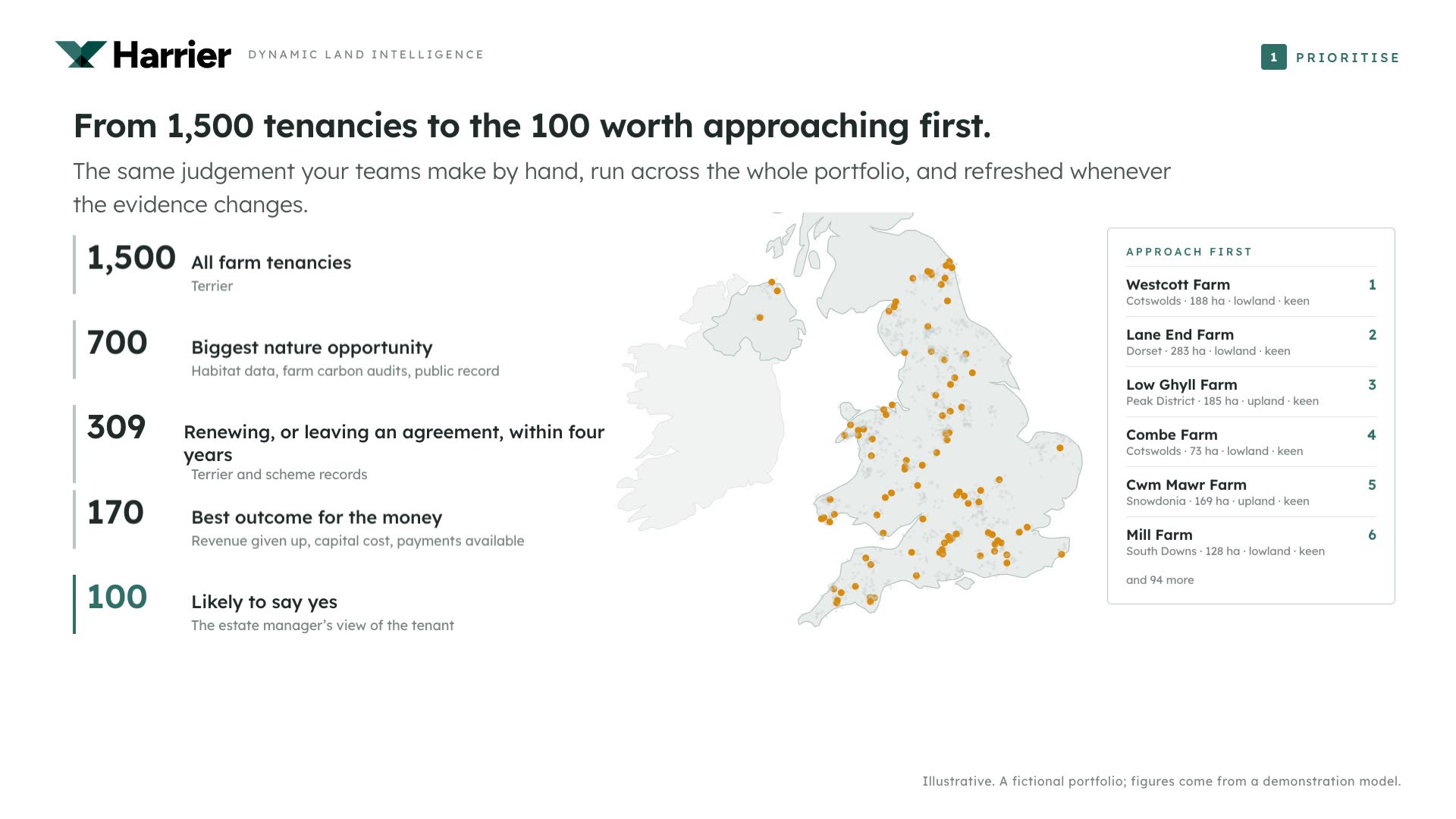
From 1,500 tenancies to the hundred worth approaching first; the offer for each farm; flood, drought and water quality shown as services the land can sell; plans that stay live.
Decisions you can explain, to whoever asks next.
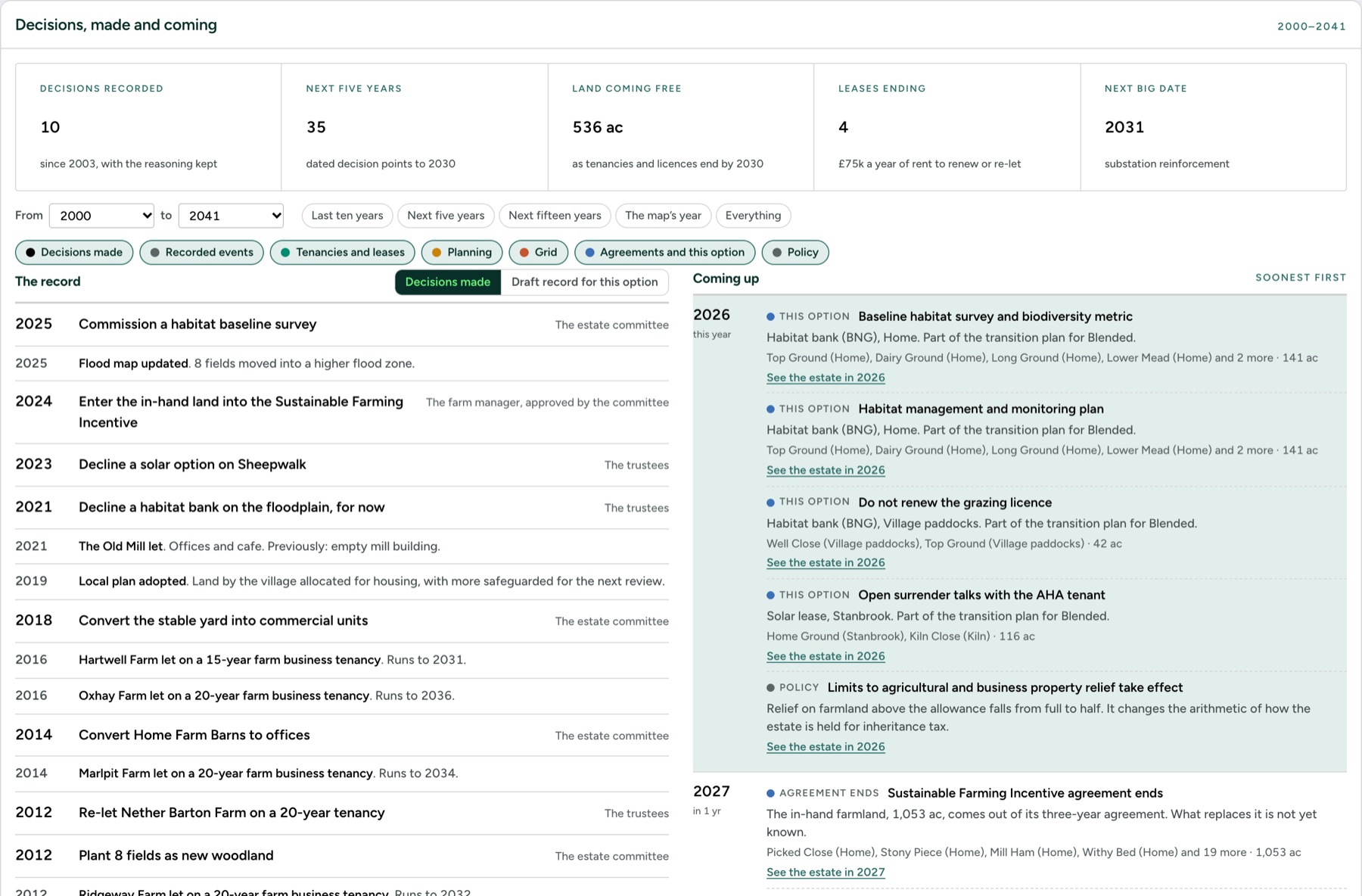
Trustees hold a duty to the next generation and to beneficiaries who may ask, years later, why a farm was sold or a habitat bank signed. Harrier gives you the options, the evidence and the reasoning, kept together.
- “If someone asks why, we point to a thick report.”Harrier records the options considered, what each would cost and why the chosen one was chosen.
- “The advice arrives as a recommendation.”Harrier shows the workings, so trustees can question the assumptions rather than take them on trust.
- “The next tax bill is coming.”See the routes to raising it, from selling land to habitat banking, priced side by side.
How Harrier helps
Options laid out for the board on the same assumptions, a decision record built as you work, and a then-and-now view of every past decision.
A new line across your land. Plan every field, before, during and after.
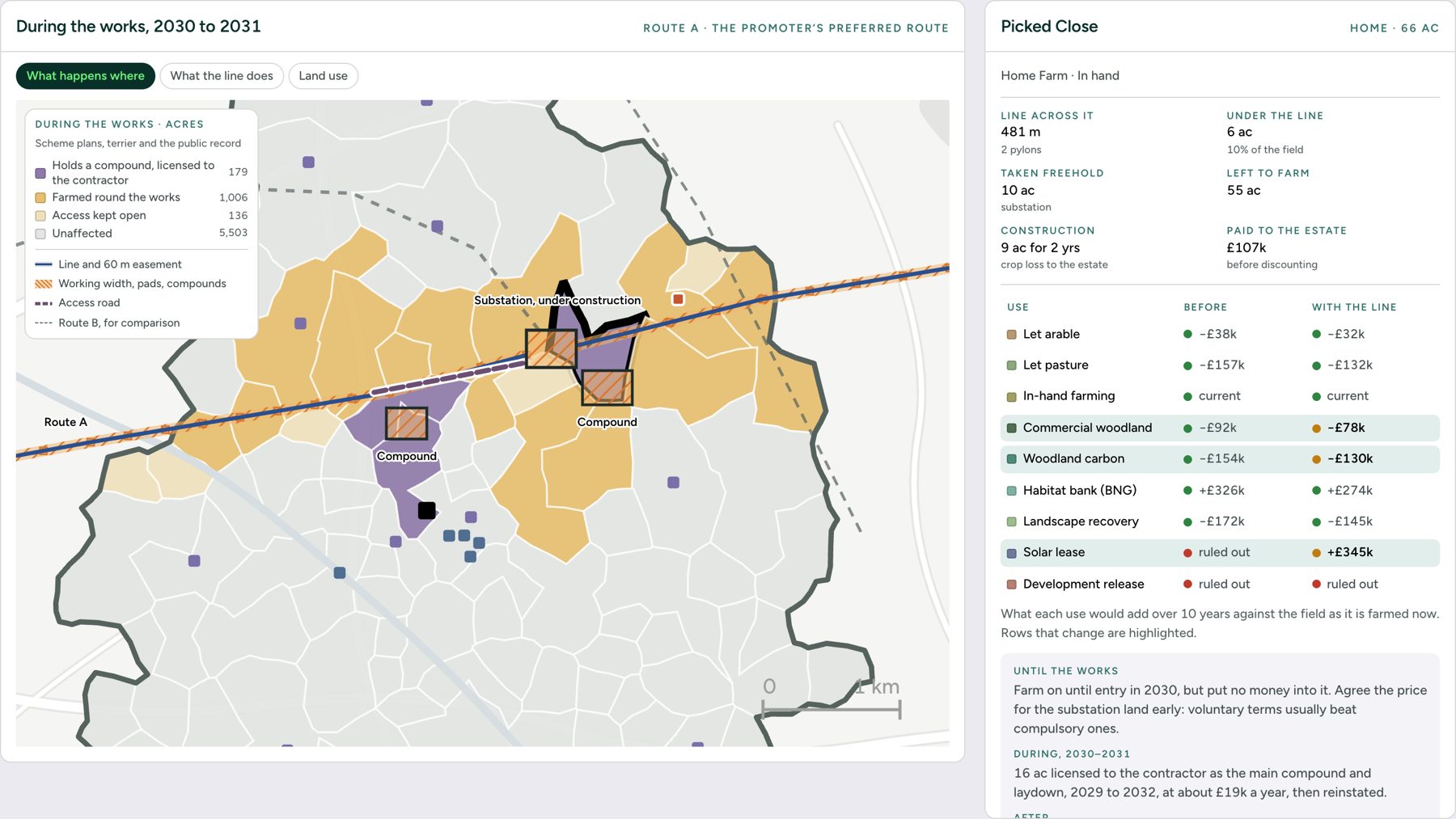
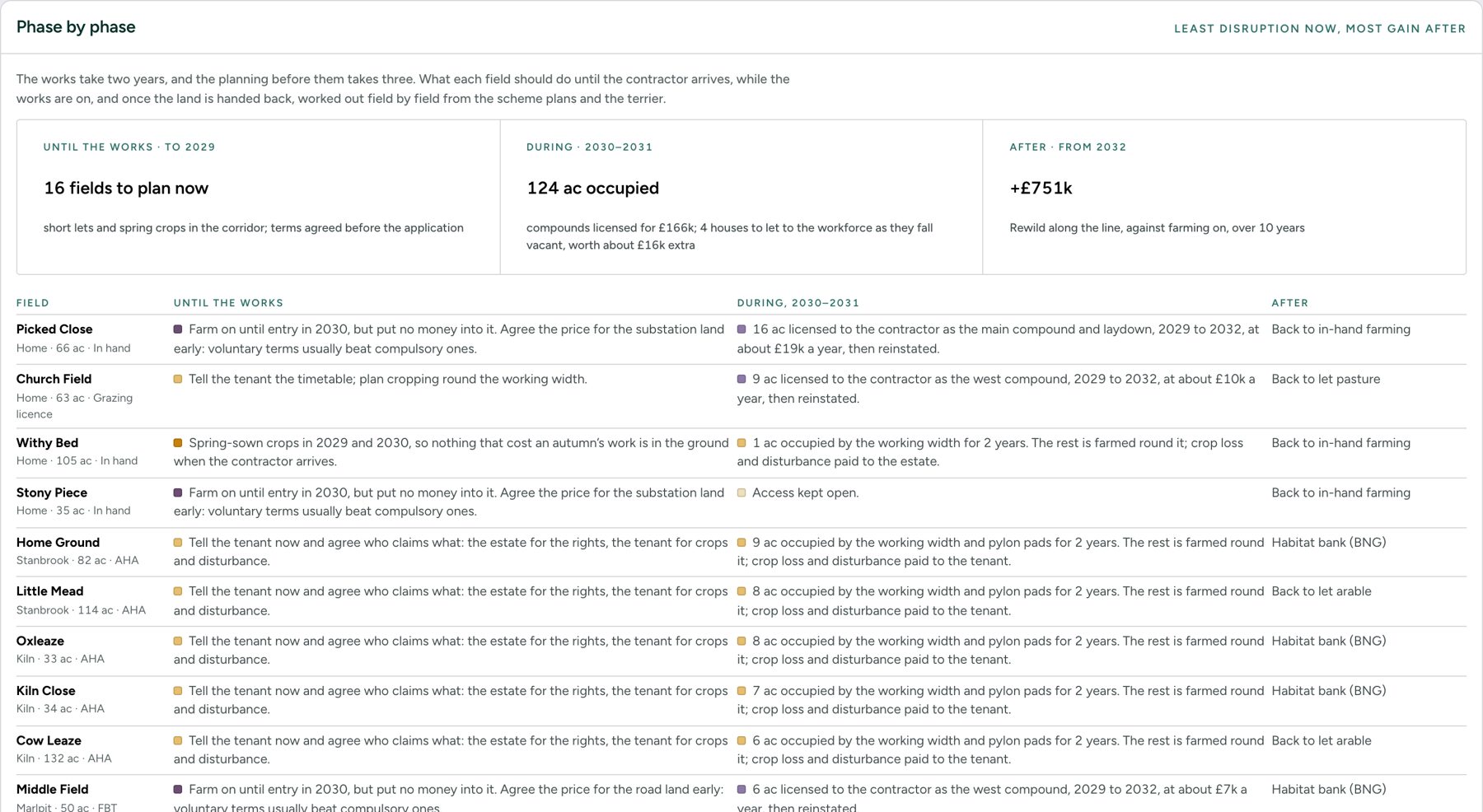
The grid upgrade and projects like it will cross hundreds of estates. Today an analyst maps the route by hand, works out whose land it crosses and opens the conversation. Harrier puts the scheme on the estate as it is, then works out what each field should do until the contractor arrives, while the works are on, and once the land comes back.
- “We map every line and every owner by hand.”The scheme plans go onto the terrier: every holding, tenant and house the route touches, what each is owed and the first conversation to have.
- “Two years of works, and nobody has planned the farming round them.”Field by field: spring crops and short lets before entry, compounds licensed to the contractor, the awkward corners put to grass, the timber sold before it is cleared.
- “Compensation pays for the land, not for what we could have done with it.”See what a route closes and what it opens: habitat the promoter has to buy, a connection at the new substation, land beside the new road.
- “Which route should we back?”Routes compared on what each takes, pays and closes, for a consultation response the promoter has to answer.
How Harrier helps
For landowners, and the agents and advisers who act for them: the scheme on the estate in one picture, a phase-by-phase plan for every field, and the evidence for the consultation.
The decisions people bring to Harrier.
Should we sign the habitat bank offer?
Which fields, on what terms, what the land is worth afterwards, and whether it could ever return to farming. Priced against holding the line.
Which tenancies should we approach first?
Opportunity, timing, value for money and the likelihood of a yes, across every holding, with the offer for each farm.
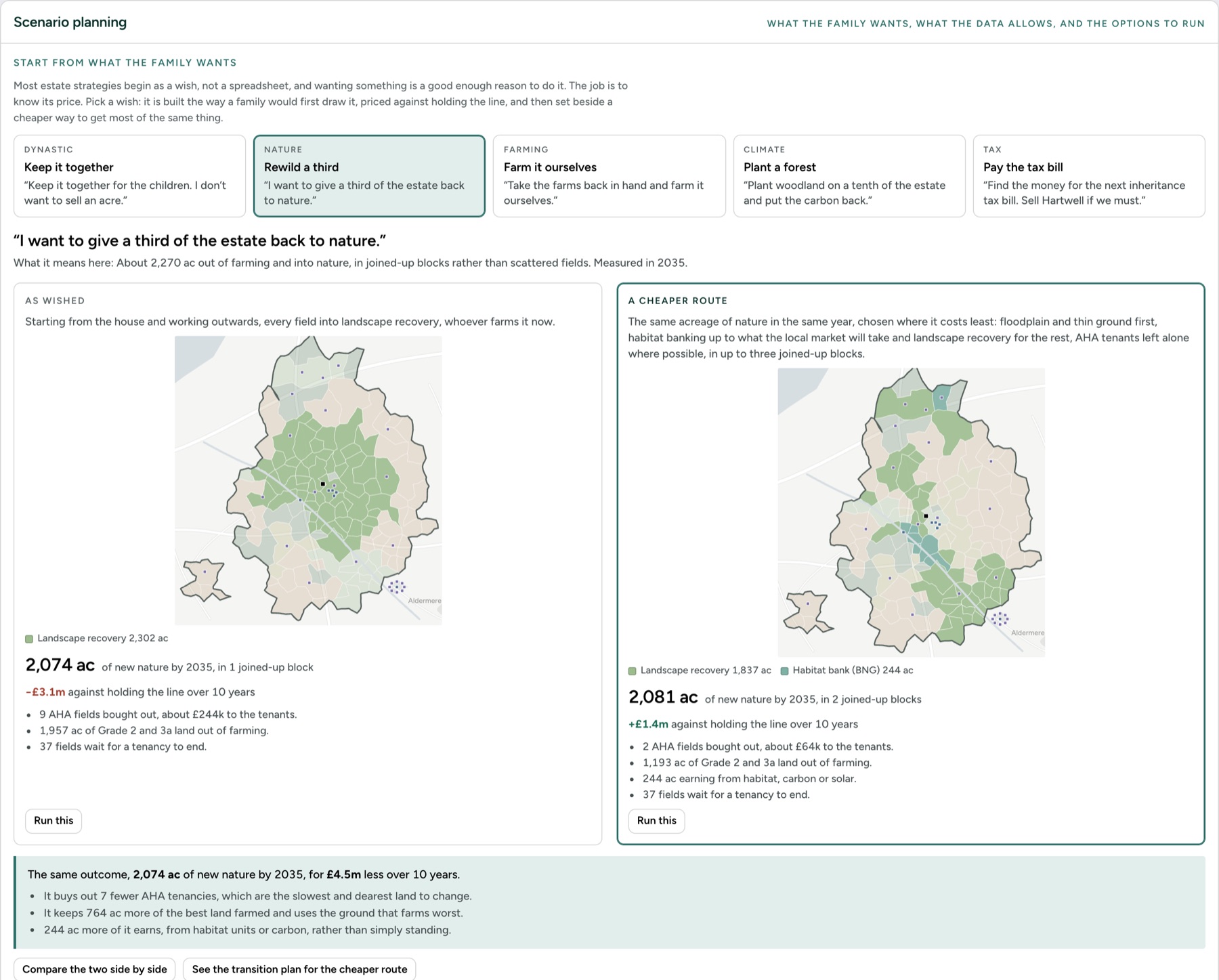
Rewild a third, at what cost?
The wish as drawn, against the version that delivers the same nature while giving up the least revenue.
How do we fund the next tax bill?
Sell a farm, release development land or bank habitat: the routes compared on certainty, timing and what you keep.
Is the land by the village worth promoting?
The chance of consent, the value if granted, the tax on disposal, and when the plan review falls.
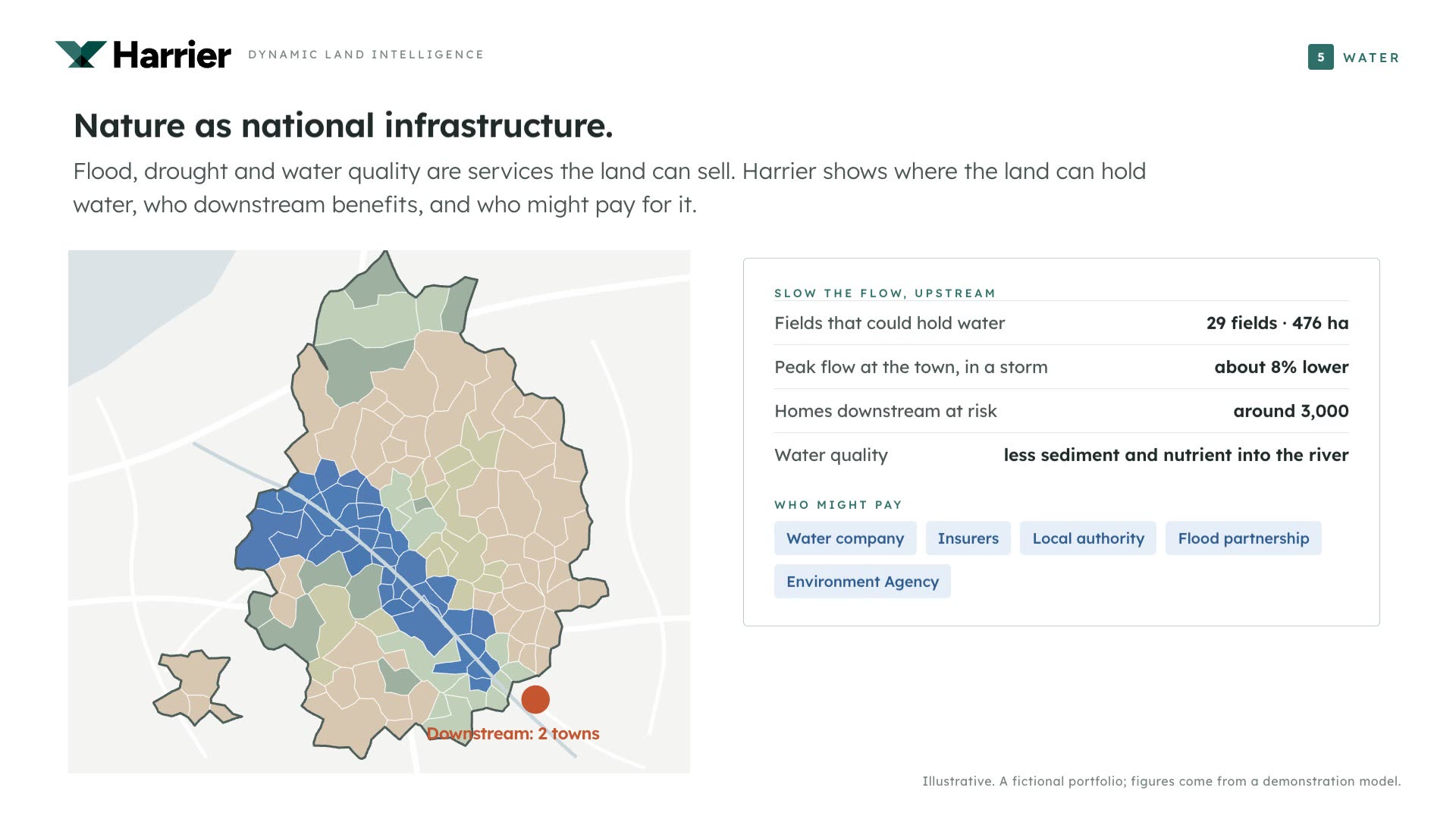
Can the land be paid to hold water?
Where natural flood management would work, who downstream benefits, and who might pay for it.
Where could solar go, and when?
Grid headroom, land grade, designations and tenancy terms screened field by field, with the lease priced over its life.
What does the next ten years look like for each place?
Ten-year plans with the climate pathway and the decision calendar built in, kept live rather than reported once a year.
A new line is coming across the estate. What now?
What the route takes and pays, what each field does before, during and after the works, and which route to back in the consultation.
Why did we decide that?
Every decision with what was known at the time, then compared with what has changed since.
Bring the decision you’re facing.
We’ll show you how Harrier would approach it, on your land.